Museum record
Pencil Nebula (NGC 2736) and filaments of the Vela Supernova Remnant, fully calibrated stack from an equatorial-mode Seestar S30 Pro
Record ID record-861b2df9-5e70-43c0-99ff-019f6eaff02b
Images and files
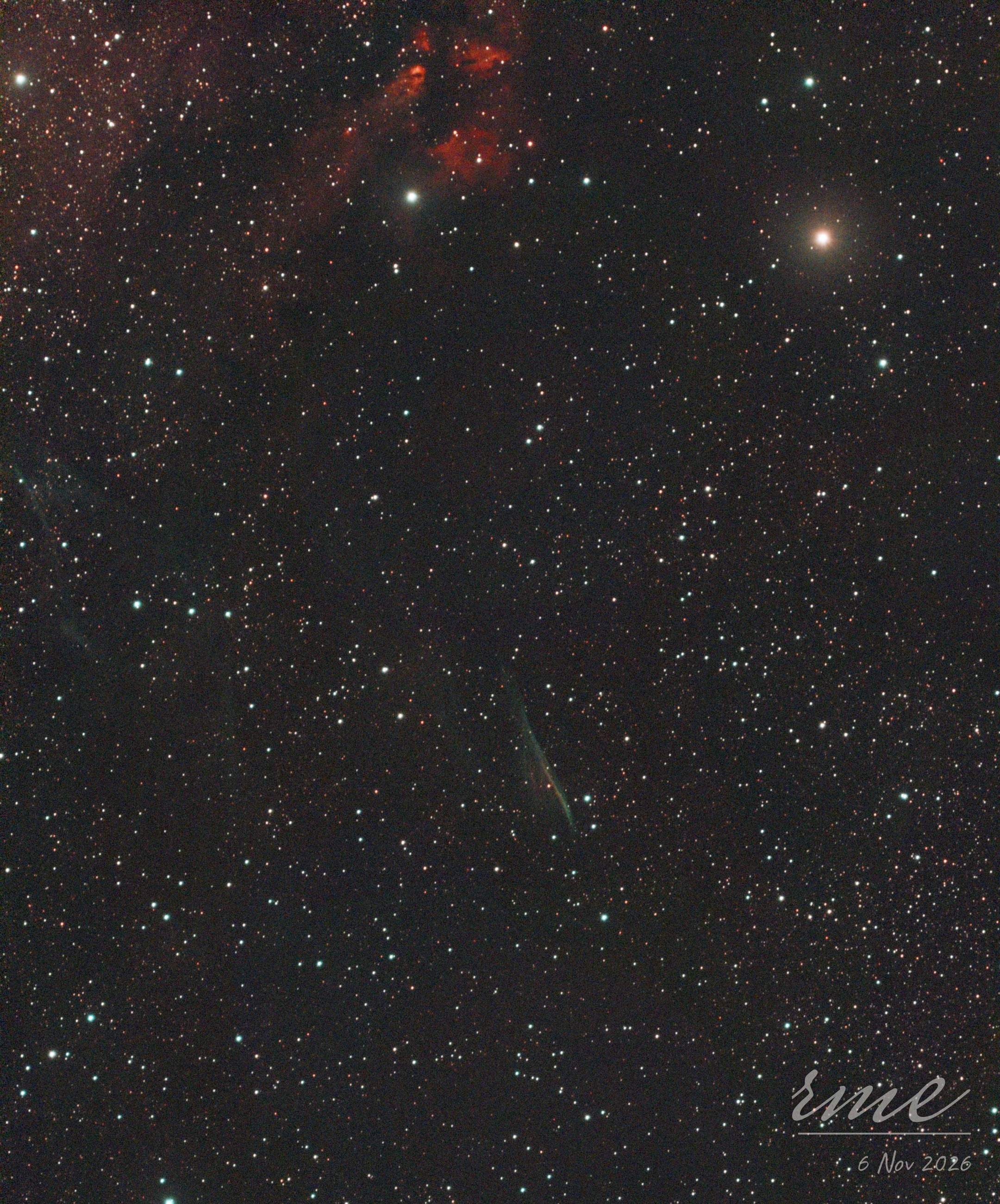
The Pencil Nebula (centre) and red filaments of the Vela Supernova Remnant (top). Signed "rme".
Download JPEG · 2,411,583 bytes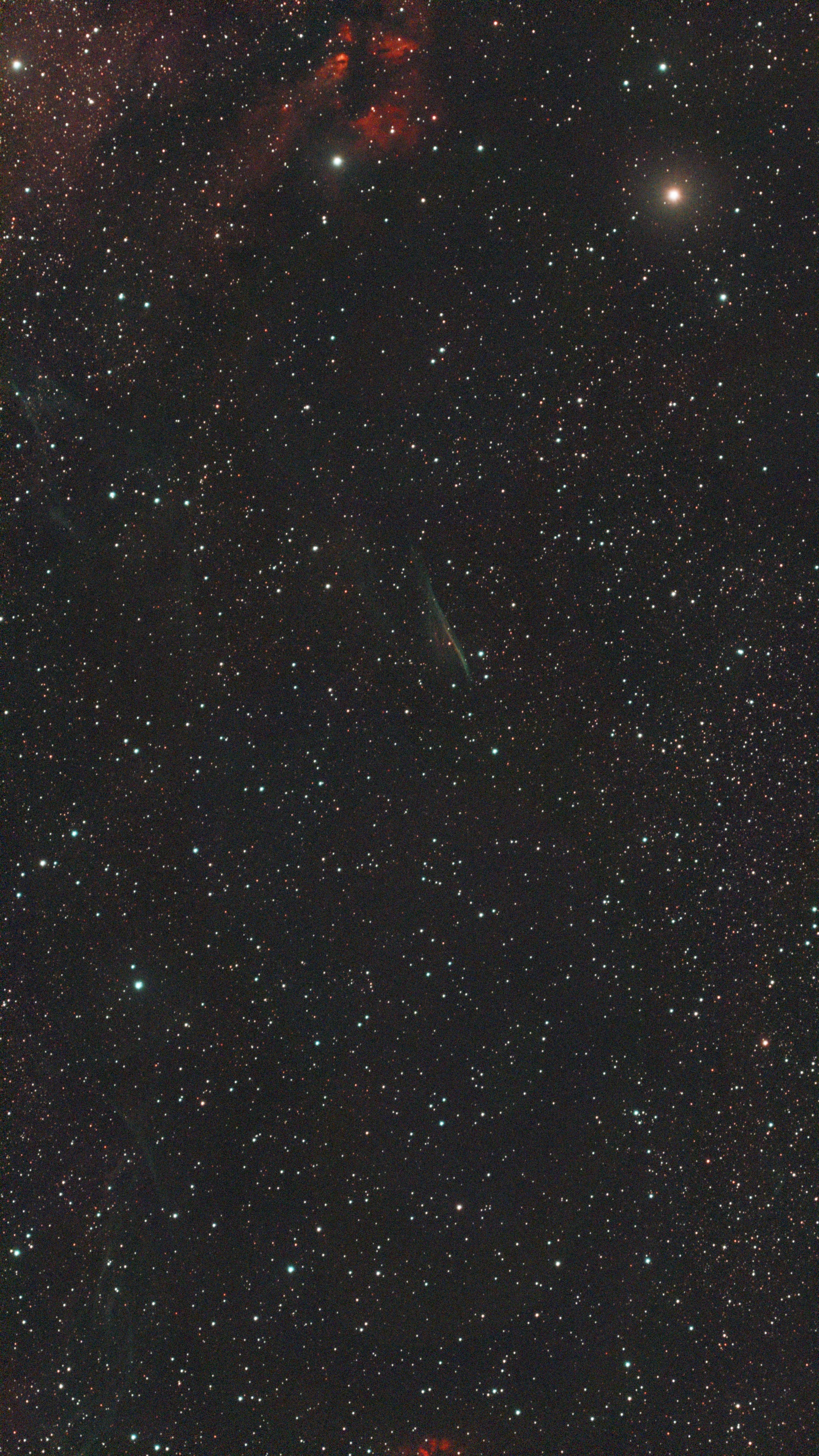
Full Seestar frame (about 2.2 x 3.9 degrees), plate-solved and colour-calibrated, unsigned.
Download JPEG · 3,606,608 bytesRecord details
- Object
- Pencil Nebula (NGC 2736) in the Vela Supernova Remnant
- Object type
- Supernova remnant (shock-front filaments)
- Right ascension (RA)
- 134.9031°
- Declination (Dec)
- -45.7046°
- Reference frame (RADESYS)
- ICRS (J2000), image centre from the Siril plate solve against Gaia DR3
- Observation date (local)
- 2026-11-07
- Start time
- 2026-11-07 02:51:43 (UTC+11:00)
- End time
- 2026-11-07 04:14:38 (UTC+11:00)
- Time scale (TIMESYS)
- UTC
- Time source
- Network time
- Telescope and instrument
- ZWO Seestar S30 Pro (30 mm f/5.3 apochromat, built-in colour CMOS), equatorial (EQ) mode
- Filter
- Light-pollution dual-band (H-alpha and OIII)
- Exposure time
- 30 s
- Number of combined frames
- 96
- Observing method
- ZWO Seestar S30 Pro smart telescope (30 mm aperture, 160 mm focal length, f/5.3; 2160x3840 colour sensor, 2.9 μm pixels), built-in light-pollution (dual-band) filter, gain 200, sensor 22–23 °C. The scope was set up in equatorial (EQ) mode and polar-aligned with the Seestar app; capture was then run from Rob's computer through the Seestar's ASCOM Alpaca interface (raw frames, not the app's live stack): goto, plate-solve centring, small random dithers every 5 frames and re-centring every 40 frames. Night of 6–7 Nov 2026: 128 frames of 30 s (02:51–04:14 AEDT). Calibration in Siril 1.4: master bias (40 frames, 0.1 ms, internal dark shutter), master dark (25 x 30 s, 21.9–22.3 °C, internal dark shutter, hot-pixel correction), master flat (30 flats through the dual-band filter, 7 Nov dawn, cloth diffuser lit by a torch, bias-subtracted). Then debayered, registered (two-pass), the frames outside the best 90% by star sharpness (wFWHM) dropped (96 of 128 used), sigma-clipped (3/3) and stacked with wFWHM weighting. Plate-solved against the Gaia DR3 astrometric catalogue (3.665 arcsec/pixel, effective focal length 163.2 mm), RBF background gradient removal, and colour-corrected with Siril photometric colour calibration (PCC) using Gaia DR3 star colours (654 stars). Then a linked auto-stretch and a mild saturation boost. No colour or detail painted in, no AI or star removal. North is up (within about 3°), east to the left. The main image is a crop with Rob's semi-transparent 'rme' signature; the full frame is attached without it.
- Bias frames
- 40
- Dark frames
- 25
- Flat frames
- 30
- Astrometric solution (plate solve)
- Solved by contributor
- Calibration level
- Calibrated
- Processing level
- Stacked
- Processing software
- Siril 1.4.0-rc2 (calibration, stacking, plate solve, PCC with Gaia DR3); capture by Lens over the Seestar's ASCOM Alpaca interface
- Description
- The Pencil Nebula (NGC 2736), a thin, straight shock front in the Vela Supernova Remnant, the expanding debris of a star that exploded about 11,000 years ago some 800 light-years away. The Pencil is part of the shock wave seen edge-on, glowing teal-green with oxygen; red hydrogen-glowing filaments of the same remnant fill the top of the frame, and fainter wisps run along the left edge. The whole remnant spans about 8 degrees of sky, so this frame shows only a slice of it.
- Uncertainty remarks
- About 48 minutes of 30 s frames; the faintest filaments need much longer. Flats were taken next morning after the scope had powered off; the focuser was returned to the same position (1270) and the filter and arm geometry were unchanged, but a small dust shift cannot be ruled out. Colours are calibrated against Gaia DR3 star colours (PCC) through a dual-band light-pollution filter, which passes mainly hydrogen-alpha (red) and oxygen-III (teal) light, so colours are not true broadband colour. Age and distance are literature values (about 11,000 years, about 800 light-years), not measured here. Site position deliberately generalised to the nearest whole degree (about 60 km) to protect a private home.
- Data quality statement
- [withheld: contains a location]
- Source
- 128 raw Alpaca sub-frames Light_NGC 2736_30s_LP_20261107-025143 ... -041408 (FITS, read-only, 2026-11-07 02:51–04:14 AEDT); calibration frames darks-library/2026-11-06-night, calib-library/flats/2026-11-07-dawn/LP, calib-library/bias/2026-11-07; Siril log siril-20261107-siril.log; colour reference Gaia DR3 (ESA/Gaia/DPAC) via Siril local catalogue
- Original FITS header retained
- Yes
- Place
- Not shown on public record pages
From the Astronomy image profile, version 1.3.0, as signed for this record version. Not shown publicly: place, coordinate and site fields, fields the profile marks sensitive (such as observing times), and the names of observers, collectors and other credited people. In the title, captions and written descriptions, coordinates, street addresses, email addresses and phone numbers are replaced with a marker; other text, including any names or times written in it, is shown as the contributor wrote it.
Cite this record
Rob Evans (2026). Pencil Nebula (NGC 2736) and filaments of the Vela Supernova Remnant, fully calibrated stack from an equatorial-mode Seestar S30 Pro. Clio Online Museum. https://cliomuseum.org/records/record-861b2df9-5e70-43c0-99ff-019f6eaff02b
Share this record
Paste the permanent link into a post or message. Social platforms unfurl it as a record card carrying the status shown here.
https://cliomuseum.org/records/record-861b2df9-5e70-43c0-99ff-019f6eaff02b
Published recordVersion 1
Creators
- Rob Evans https://orcid.org/0009-0004-6391-4464 (opens in a new tab) (verified with ORCID)
Version and provenance
- Version identifier
version-68e8e959-a8a4-4949-8a72-b9897ddd67b0- Canonical commitment
sha3-384:48bbe95169d1d983e1331b1917080fab222a5e8c756205cfec24cea31dce51d57833c4c9e33b59a474a5c4840f30636a- Accepted
Evidence profile and standards
- FITS
- World Coordinate System (WCS)
- IVOA Provenance Data Model
Last updated: . Report a problem to Clio support.