Museum record
Helix Nebula (NGC 7293), 60-minute stack, dual-band filter, colour-calibrated, Seestar S30 Pro
Record ID record-c2d81e5f-aad0-4e78-9667-2b064af5bfde
Images and files
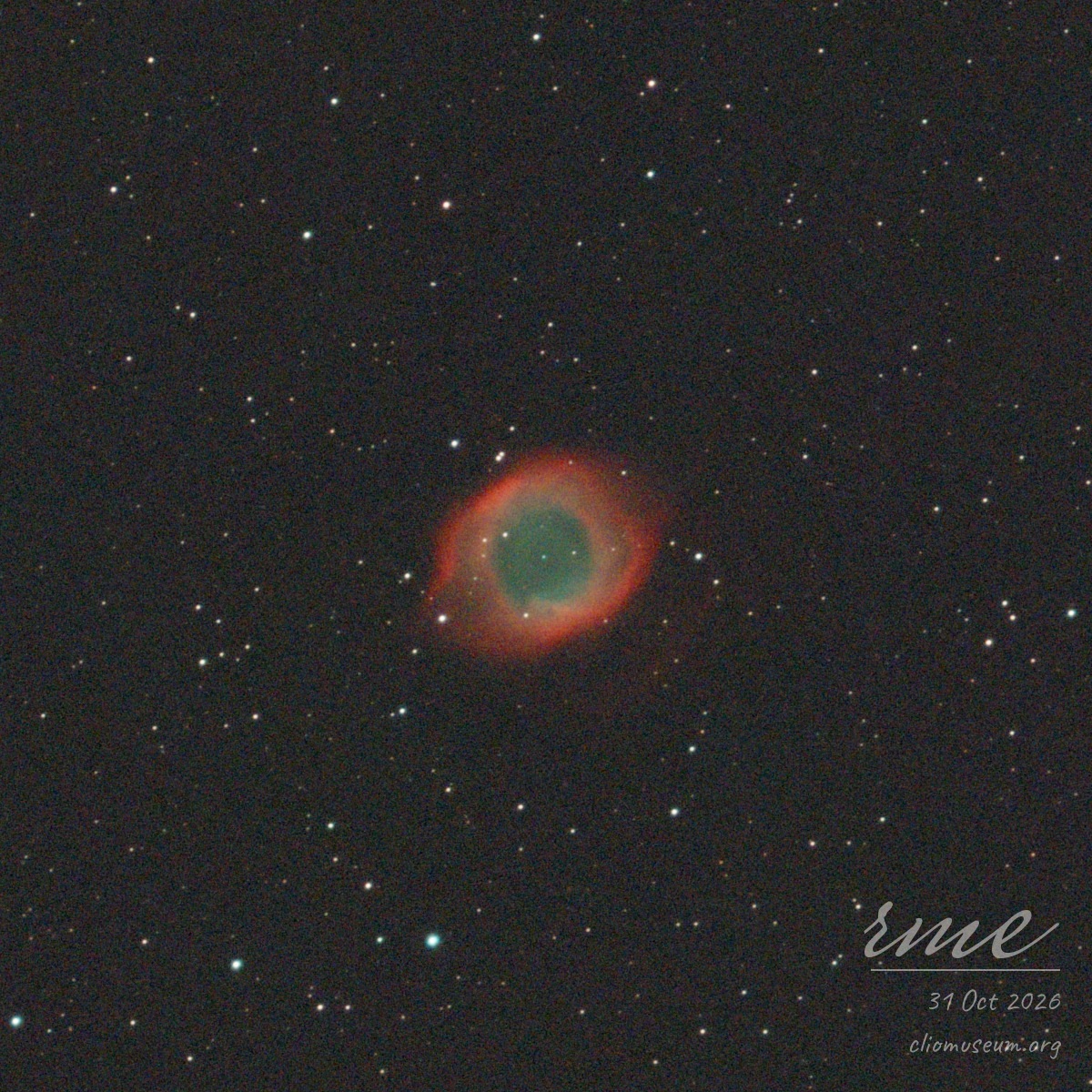
The Helix Nebula: red hydrogen-alpha ring around a blue-green oxygen core. Colour-calibrated against Gaia DR3 star colours. Signed "rme".
Download JPEG · 573,282 bytes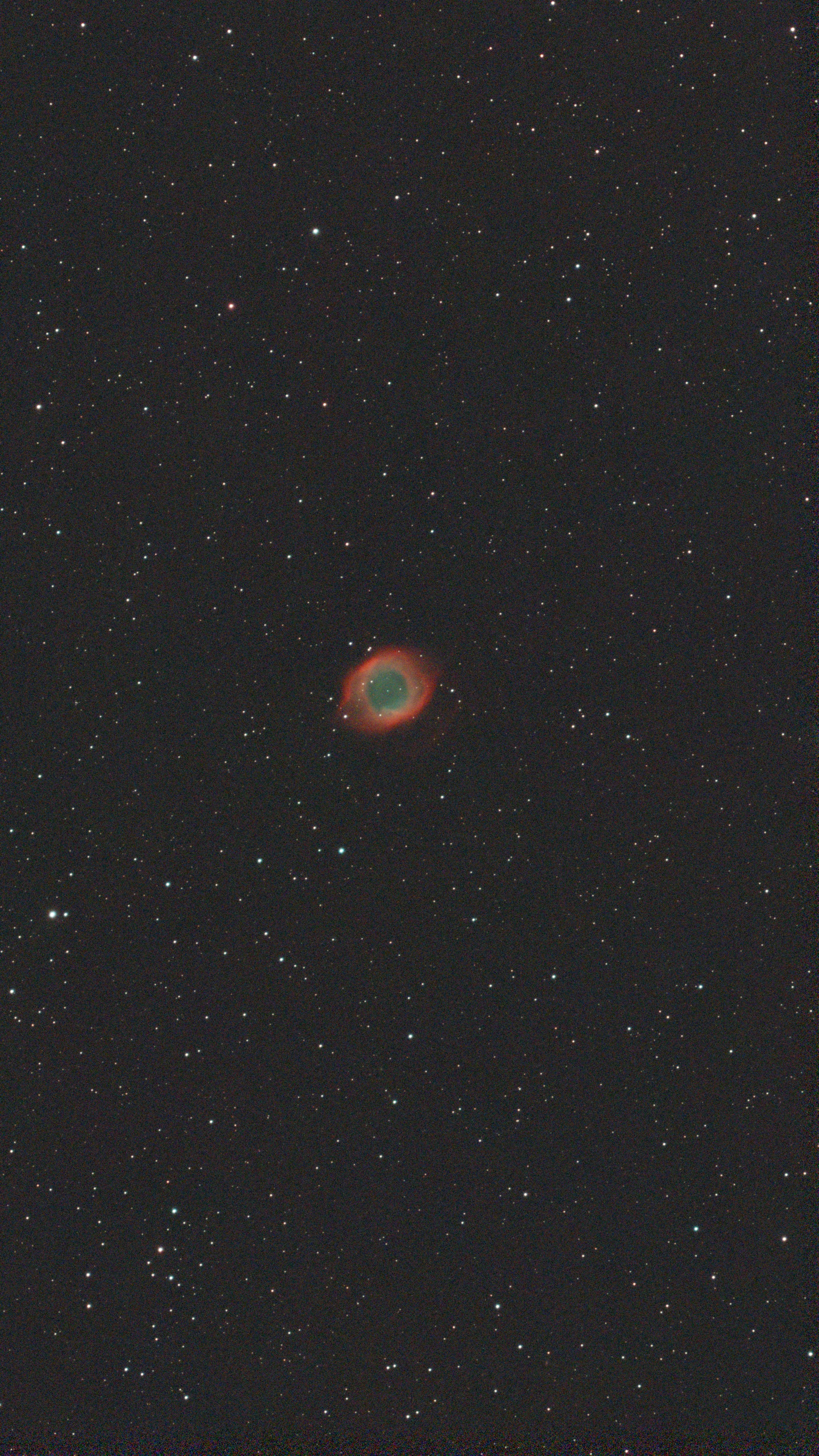
Full Seestar frame (about 2.2 x 3.9 degrees), plate-solved and colour-calibrated, unsigned.
Download JPEG · 3,253,411 bytesRecord details
- Object
- NGC 7293 (Helix Nebula)
- Object type
- planetary nebula
- Right ascension (RA)
- 337.473 (unit not recorded)
- Declination (Dec)
- -20.7373°
- Reference frame (RADESYS)
- ICRS (J2000), image centre from the Siril plate solve against Gaia DR3
- Observation date (local)
- 2026-10-31
- Time scale (TIMESYS)
- UTC
- Time source
- Phone network
- Telescope and instrument
- ZWO Seestar S30 Pro (30 mm f/5.3 apochromat, 160 mm FL, built-in colour camera 3840x2160, 2.9 μm pixels)
- Filter
- LP dual-band (H-alpha / OIII), built in
- Exposure time
- 60 s
- Number of combined frames
- 60
- Observing method
- ZWO Seestar S30 Pro smart telescope (30 mm aperture, 160 mm focal length, f/5.3; 3840x2160 colour sensor, 2.9 μm pixels), equatorial mode, built-in LP dual-band (H-alpha/OIII) filter, gain 200, sensor 27–30 °C. 85 frames of 60 s captured from 22:11 to 00:32 AEDT. Version 2 (reprocessed 2–3 Nov 2026) in Siril 1.4: debayered and registered (two-pass; 67 frames registered), the best 60 kept by star sharpness (wFWHM), sigma-clipped (3/3) and stacked with wFWHM weighting (60 min total). The stack was then plate-solved against the Gaia DR3 astrometric catalogue (990 image stars; 3.660 arcsec/pixel, effective focal length 163.4 mm) and colour-corrected with Siril photometric colour calibration (PCC) using Gaia DR3 star colours (978 stars), with RBF background gradient removal before and after. Then a linked auto-stretch and a mild saturation boost. No colour or detail painted in, no AI or star removal. No darks or flats applied. The main image is a crop around the nebula with Rob's semi-transparent "rme" signature; the full frame is attached without it.
- Bias frames
- 0
- Dark frames
- 0
- Flat frames
- 0
- Astrometric solution (plate solve)
- Solved by contributor
- Calibration level
- Partially calibrated
- Processing level
- Stacked
- Processing software
- Siril 1.4.0-rc2 (plate solve + PCC with Gaia DR3)
- Description
- The Helix Nebula (NGC 7293) in Aquarius, a planetary nebula: the glowing gas shell thrown off by a dying Sun-like star, about 650 light-years away. Red shows hydrogen-alpha in the outer ring and the blue-green core shows doubly ionised oxygen. One hour of 60-second frames, restacked from the raw sub-frames and colour-calibrated against Gaia star colours.
- Uncertainty remarks
- Colours are calibrated against Gaia DR3 star colours (PCC), but the dual-band filter passes mainly H-alpha and OIII light, so nebula colours are still not true visual colour. Spectrophotometric calibration (SPCC) was not used because it crashes in Siril 1.4.0-rc2. No dark or flat frames, so faint gradients and hot pixels may remain. The plate solve shows the north–south axis runs vertically to within about 1 degree; the image keeps the Seestar's display orientation. Distance (about 650 light-years) is the literature value, not measured here. Site position deliberately generalised to the nearest whole degree (about 60 km) to protect a private home.
- Data quality statement
- 60 of 85 frames stacked after registration and star-sharpness filtering. Astrometry and colour from Gaia DR3 via local Siril catalogues (astrometric catalogue for the plate solve; PCC for colour). Version 1 had automatic colour balance only and was not plate-solved; version 2 replaces it with catalogue-based colour calibration and a plate-solved centre. GPS and camera metadata removed from the published images; the raw FITS (which hold the site position) are kept privately.
- Source
- Seestar S30 Pro sub-frames Light_NGC 7293_60.0s_LP_20261031-221300 to _20261101-003214 (85 FITS); Siril log siril-20261102-siril.log; colour reference Gaia DR3 (ESA/Gaia/DPAC) via Siril local catalogue
- Original FITS header retained
- Yes
- Place
- Not shown on public record pages
From the Astronomy image profile, version 1.1.0, as signed for this record version. Not shown publicly: place, coordinate and site fields, fields the profile marks sensitive (such as observing times), and the names of observers, collectors and other credited people. In the title, captions and written descriptions, coordinates, street addresses, email addresses and phone numbers are replaced with a marker; other text, including any names or times written in it, is shown as the contributor wrote it.
Cite this record
Rob Evans (2026). Helix Nebula (NGC 7293), 60-minute stack, dual-band filter, colour-calibrated, Seestar S30 Pro. Clio Online Museum. https://cliomuseum.org/records/record-c2d81e5f-aad0-4e78-9667-2b064af5bfde
Share this record
Paste the permanent link into a post or message. Social platforms unfurl it as a record card carrying the status shown here.
https://cliomuseum.org/records/record-c2d81e5f-aad0-4e78-9667-2b064af5bfde
Published recordVersion 3
Creators
- Rob Evans https://orcid.org/0009-0004-6391-4464 (opens in a new tab) (verified with ORCID)
Version and provenance
- Version identifier
version-20ab9f32-f50e-416b-b750-5e229cdda0d7- Canonical commitment
sha3-384:f1a2a88bda9d4c6ae4734009e3f1b100012bd09c7883099a2f594720234ceae2f900c1d6a6a3a2e43bf4e8fd69c4a5a4- Accepted
- Previous version
version-5d1cc2b9-e4dc-4daa-a489-45e05164f3b4
Evidence profile and standards
- FITS
- World Coordinate System (WCS)
- IVOA Provenance Data Model
Last updated: . Report a problem to Clio support.